The Ghost of Richard III is a poem by Christopher Brooke, where the titular ghost retells his life story from beyond the grave in three sections. Written in 1614, it feeds off a host of earlier material produced about Richard, but also adds additional layers of psychology and motivation to the fictive imagining of this historical figure. Beyond produced an adaptation of the poem for a one off live streamed performance during the 2020 COVID pandemic. This video is once again be available.
1 His Character. The opening of the poem describes his progress through medieval society, and the ways in which he prepares himself to be a tyrant.
2 His Legend. Digs into the better known part of his story, as he makes his way through the rungs towards power, usurps the throne and commissions the murders of the princes.
3 His Tragedy. Covers the endgame of his life, introducing Richmond as his antagonist, and closing with Richard’s death at the battle of Bosworth.
Robert Crighton discusses the text with Dr Jitka Štollová, recorded in the run up to his adaptation.
A series of initial exploring sessions were made, but is currently incompletely archived. The first session is available for our patreons here. We will return to this text in the future.
This was the first major dip into the world of Richard III in the aftermath of his death. We have also performed Bosworth Field by Sir John Beaumont, and held a panel discussion about what happened to his reputation after his death. There were also ballads on Richard, which can be heard via the wonderful Passamezzo. More on this work to follow…
Beyond Shakespeare Presents…
The Ghost of Richard III by Christopher Brooke
Adapted for the stage and performed by Robert Crighton
King Richard III wants to set the record straight about his life. His bones having been disturbed, his conscience afflicted, he is summoned from beyond the grave to tell his life story, and he leaves nothing out. From his early days learning how to out politic the most dangerous politicians, his working up to the position of Protector, the murder of the princes and his final fall – Richard will not let up till all is told.
Based on The Ghost of Richard III by Christopher Brooke, a narrative poem from 1614, and brought to life by the Beyond Shakespeare Company for the Quay Theatre.
Film produced by Paul Press, with Dan Newman
Lighting and theatre technical support – Joe Fawcett
Backstage crew – Alan Scott
Publicity Photography – Simon Nader
Online technical support – Tim Register
Commissioned by Sharon Buckler, Artistic Director of the Quay Theatre
Many thanks to everyone at the Quay Theatre for supporting this show during the plague years. Original Live Stream was on Tuesday 21st July 2020, and produced to support the Quay Theatre during the COVID pandemic. The Quay is a community theatre in Sudbury, Suffolk, which – like all theatres at the time – could not open its doors for live performance. This production was a celebration of the wonderful space that was closed; a way of helping keeping it alive until it could reopen. Which it did, and thrived. To support the theatre, which give us this chance to produce work in their space, go to their website and donate – https://www.quaysudbury.com/
The Background to the Production

In March 2020, Beyond was scheduled to perform a mixed programme show at the Quay Theatre. As the approaching threat of COVID became clear we cancelled the show, prior to the official lockdown the week following. Following the cancellation, over a number of conversations with the then Artistic Director at the Quay Sharon Buckler, the possibility of producing a live streamed show at the now empty theatre was discussed. Funding had been found to film a number of live and pre-recorded shows to prompt donations to the closed theatre space. The funding only paid for the technical and filming side of things, but it was agreed that Beyond would produce the show for free, on the understanding that the film would be theirs to share for free online after the initial run.
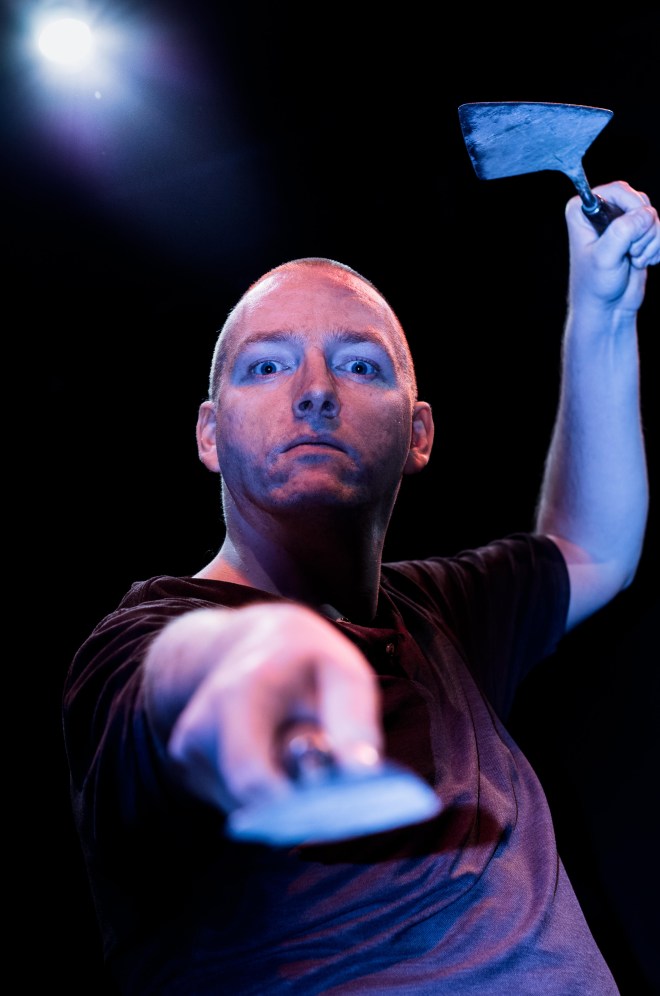
Robert Crighton: “I knew that it had to be a one person show, and I was the person, as we were in lockdown and there was no ability to prepare anything with other contributors. I had been working on the poem as part of our exploring work, and I knew it had potential to be a good solo show. At the same time as preparing the text, our zoom exploring sessions had increased enormously, so I only had a couple of hours in the mornings to prepare the text. Sharon agreed and discussions about how to film the show began. By this time lockdowns had eased, but the world was still very closed off, so everything was prepared remotely. I did have a couple of chances to work in the Quay space, but without anyone else in attendance, as we were still heavily socially distanced.
I decided that we should film the play the opposite way to normal – as in, the cameras were to be placed facing the empty seats, to remind the audience that the theatre was still empty. Not that this was apparent for most of the show, as the lighting didn’t pick up the seats once we got started!
The original plan for the production was that I was playing a nightwatchman guarding the site of the excavation of Richard’s bones – and at some point this character was to be possessed. Hence the setting featured hi-vis jackets and other elements of a dig. Unfortunately, in part due to the general closing down of everything, I wasn’t able to pull together a costume for the nightwatchman that either looked right, or was loose enough to move in. For the photoshoot with Simon Nader a little prior to the show I wore simple blacks, which I then reluctantly used (with some adaptation) for the show itself. As an able bodied actor I didn’t want to be embodying the role directly, but a compromise in those very specific circumstances was necessary.


The full team behind the performance only gathered fully on the day of the show. We ran the lights and sound cues with the Quay’s technician Joe Fawcett, and then ran the show for the cameras. It was a two camera set up, one wide shot and another closer moving camera operated by Dan Newman. Paul Press live vision mixed the show between the two shots, and ran the live stream that evening.
Though a relatively simple set up, the recording came out very well, and I have to thank the Quay team for making this event happen. The original live stream on YouTube was removed after hitting hundreds of views, and combined with the live stream on Facebook, it hit something like a 1,000 views. Hopefully this re-release will continue that trend.”
 beyondshakespeare.org