Robin Hood and the Friar is a short play written prior to 1560, designed to extract money from a local audience for a good cause via the dramatic application of staged violence. Like it’s sister play Robin Hood and the Potter, it was randomly printed in the latter pages of a 1560 edition of A Merry Jest of Robin Hood, without any kind of context, stage direction, or useful notes. It doesn’t really have an individual name, the two plays are labelled as ‘Heere beginneth the play of Robin Hood, very proper to be played in May games‘. Which gives us some context, but there are issues.
Firstly, the two plays are clearly separate texts; they are clearly designed for the same sort of event, and written by the same author, but most likely for two different years, or at different times during the same event. Either way, there should be a span between the two stories. Though some people do insist that you might play the two plays back to back without a break, it would be (frankly) very weird. But that’s not the weirdest part of the three pipe problem which are these very odd plays. Because they are printed without stage directions, it is hard at times to figure out what precisely is going on and when. To a degree this does not matter, as the plays have a plot only in so much as it sets up a fight. The fight is all that matters, and presumably the plays were designed to demonstrate the fighting abilities of local performers amongst other May game merriment.
The opening of the play, which features a boiler plate introduction which performers presumably used every year, talks of a previous encounter between Robin and Friar – where the Friar steals Robin’s purse after (you’ve guessed it) a fight. It seems to be a call back to something from the past, but then the event described is almost reenacted in the following sequence when they both meet. Having delivered the back story, Robin sends Little John to find Friar Tuck for a rematch of their last meeting. Little John goes and… well disappears. Does Little John find him in a lost scene? It doesn’t seem so. When we then have the appearance of Friar Tuck, he isn’t being brought by Little John, but under his own steam, telling the audience that he is searching out Robin, who he doesn’t seem to know, only know of. Tuck doesn’t recognise Robin when he enters, even though they have in theory already met. Is this scene a fumbled flashback of their first meeting, or just fudged storytelling that misses out that Friar Tuck didn’t recognise Robin when he stole his purse. Perhaps he had his hood up, so the Friar didn’t fully see him when they first met?
And the answer is…
It doesn’t matter, so long as there is a fight!
In 2018, we produced a short audio adaptation of the play, where we stumbled over the other big issue with the text – what happens over the water? Having generally sized each other up for the fight, the text – quite randomly and with no real logic – makes Robin ask Friar Tuck to carry him over a river. Why? Because.
ROBIN: Hark, friar, what I say here –
Over this water thou shalt me bear,
The bridge is borne away.
FRIAR TUCK: To say nay I will not –
To let thee of thine oath it were great pity and sin – [urm, which oath was that?]
But upon a friars back, and have even in!
ROBIN: Nay, have over!
So, Friar Tuck agrees to carry Robin on his back (because), and there’s a sense of something physically happening (“Nay, have over!”) but no direction. And then we get this bit of word play…
FRIAR TUCK: Now am I, friar, within, and thou, Robin, without,
To lay thee here I have no great doubt.
Now art thou, Robin, without, and I, Friar, within!
Lie there, knave – chose whether thou wilt sink or swim.
Now, various editors have suggested that the action runs thusly – that Friar Tuck picks up Robin and throws him into the water after the first two lines of Friar Tuck (“no great doubt”, splosh) and the next two lines are amended/ignored to fit. For the audio adaptation we followed this logic, because it kinda worked. Someone got wet, yay!
Then, in 2025, we produced a version of the play for a Tudor Fete in Lavenham, Suffolk. There wasn’t a budget for the show, so we removed Little John (cutting his lines and few of Robin’s from the opening) but otherwise performed as writ. As you can see from the images below, we used audience volunteers and plastic pool noodles for the fight scenes, which were appropriately silly, and a piece of blue cloth for the river. It seemed to Liza Graham (Robin) and myself Robert Crighton (Friar Tuck), going through the text from the source once again, that the action flowed more like this.
ROBIN: Hark, friar, what I say here –
Over this water thou shalt me bear,
The bridge is borne away.
FRIAR TUCK: To say nay I will not –
To let thee of thine oath it were great pity and sin –
But upon a friars back, and have even in!
[FRIAR TUCK BENDS OVER TO CARRY ROBIN, ROBIN KICKS HIM INTO THE WATER, SAYING:]
ROBIN: Nay, have over!
[STRUGGLING IN THE WATER, FRIAR TUCK SAYS]
FRIAR TUCK: Now am I, friar, within, and thou, Robin, without,
To lay thee here I have no great doubt. [Repeats the sentiment, whilst crawling to Robin]
Now art thou, Robin, without, and I, Friar, within!
Lie there, knave – chose whether thou wilt sink or swim. [PULLS ROBIN INTO THE WATER]
Whilst this interpretation is not necessarily authoritative, it does fit the text as writ, and doesn’t require fudging or changing of lines to work. If it seems clunky that Friar Tuck basically says the same thing twice, well, it is. But he also says “ragged knave” approximately four million times in the play text, so that’s hardly out of place.
The play ends with the oft mentioned fight, which we staged with audience members, followed by a song to cover the end dance, which we again only marked through with an audience member as the “lady free”. The rude dialogue was mildly tweaked for a family audience, but the comic sentiment left in place.
Nobody died. Except our dignity.
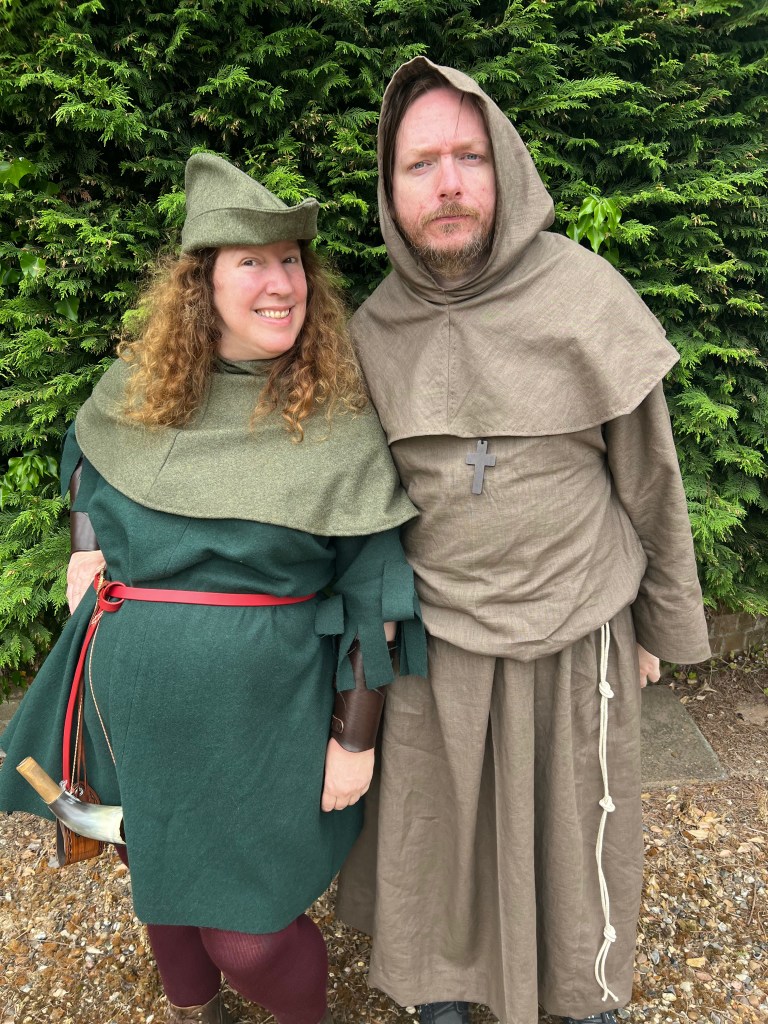


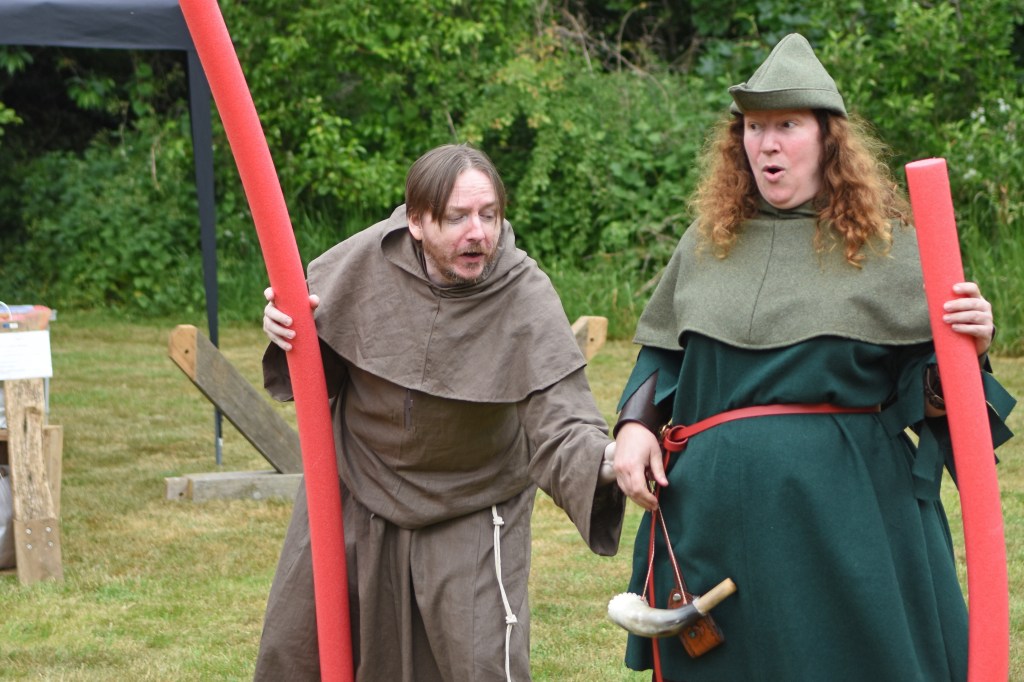
The play variously makes little sense, but that is probably down to missing stage directions, or actor parts that got detached from whatever manuscript ended up in the hands of the printer. So changes, additions, variations are all part of the fun. More fighting, more singing, more dancing: the play demands it!
If you would like to see more of this sort of thing, or would like to request a performance of this or other Robin Hood plays at an event near you, get in touch. The worst that can happen is that we’ll say yes.
References: Martin Wiggins with Catherine Richardson, British Drama vol 1, 1533-1566; Darryl Grantley, English Dramatic Interludes 1300-1580; Thor Ewing, The Original Robin Hood; The source text can be found variously online or here.
 beyondshakespeare.org