Like ‘Mystery’ plays, this is one of those slightly tricksy terms that never quite satisfies, but is difficult to get away from. If medieval Mystery plays are mostly narrative driven, stories from the Bible and the surrounding tradition; morality plays are mostly about ideas – initially ideas about God, but also just questions of thought, ethics, class, etc. which the plays (in theory) try to wrestle with. There is a lot of crossover here with the Tudor Interlude (Trademark Pending) which are often morality plays as well – so do pop over to our Tudor Interlude page for more on that span of material.
Medieval Morality
There is a relatively small number of surviving pukka medieval morality plays. Though they are all very similar at their core structure, they’re wildly different in their dramatic presentation. During the medieval period, more so than in later ages, the context of where you staged a play fundamentally changed what was produced. Two plays might wrestle with the same basic question, but the way they present that are often massively different.
Roughly speaking, these medieval plays demonstrate the life of mankind, through inevitable temptation towards repentance, presenting the road map towards getting a good afterlife. This is presented by allegorical characters who represent concepts, rather than real people. So a personification of all Humanity will be accosted by a representation of Lust, and protected by Chastity, say. This figure of all Humanity may been seen through a life cycle, from birth to death (see Castle of Perseverance, or The World and the Child), or focus on a moment in their life, in early youth (see Youth) or towards their death (see The Summoning of Everyman). The fragmentary Dux Moraud tells a more soap operatic story of a man who has an affair with his daughter, and features a double homicide. It might not even be called a morality play, beyond that he repents at the end – the absence of the full text means we give it the benefit of the doubt. In Mankind, the figure of Mankind is drawn away from the path of virtue towards vice by giving up hope of salvation. In all these plays, there is always some move towards ‘sin’ in some form, and a push back towards a ‘good’ way of life. The figure of death and of demons of all sorts appear a lot, though later morality plays will more towards more abstract vices to play with.
The Core ‘Medieval’ Morality Plays – useful links
1350 – The Pride of Life (Fragment – missing the ending) – The King of Life proclaims a challenge on Death, believing that he is invincible. He is wrong. The Plain Text audio, First Look Exploring Session, Live Performance (Raw footage from 2015), Edited version, best takes (2015).
1400 – The Castle of Perseverance – an epic telling of Humanity’s fall from grace, losing possession of the castle of Perserverance. In death, his soul is judged. First Look Exploring Sessions.
1400 – Dux Moraud (Fragment) – maybe not strictly speaking a morality play, as we only have one actors part of the text, but it sure fits the structure. A man has an affair with his daughter, gets her pregnant, persuades her to murder his wife – he leaves on a journey where the sound of church bells draws him to repentance. The Plain Text, The Live Show, Discussing the Show.
1460 – Wisdom or Mind, Will, and Understanding – First Look Exploring Session.
1465 – Mankind – First Look Exploring Session.
1490 – Nature by Henry Medwall – Exploring Video
1500 – The World and the Child, or Mundus et Infans – Like Castle this is a play that tells of a whole life cycle of a representative of humanity, albeit on a much smaller scale. A child grows into a man in the full sight of the world. He is drawn towards sin, and in age repents. Full Cast Audio Adaptation & Spoilers, Discussion episode with Professor Greg Walker, Podcast Exploring Session, First Look, and Second Look, take 1, take 2 explorings on YouTube.
1500 – The Summoning of Everyman – bit of an outlier as this is a translation of a Dutch play that might have only been produced for publication. A grown man meets Death and scrambles to prepare for the afterlife, realising that he has held too fast to the world. First Look Exploring Session.
Morality Play into Tudor Interlude
Once we’re more firmly into the Tudor reigns, the moral interlude becomes a bit more wide ranging in style and theme – the Interlude becomes a thing, which overlaps with Moral plays, so that distinctions can get a bit untidy. There is a lot of overlap between a Morality play, a Moral Interlude, and your just plain Interlude – see other webpage for Tudor Interludes. Plays present not just a question of how to live, or (perhaps more importantly) die well, plays begin to explore other questions about education, the state, and the real world. Increasingly allegorical figures drift away and ‘real’ people become the focus. So we will avoid talking about Interludes as open handed entertainment, and try to list below some of the more morally focused plays. Feel free to discuss.
To help you play with some of the genre markers of morality plays / Tudor Interludes, we’ve produced our Moral Interlude Bingo Card – you can download a b/w printable version here.
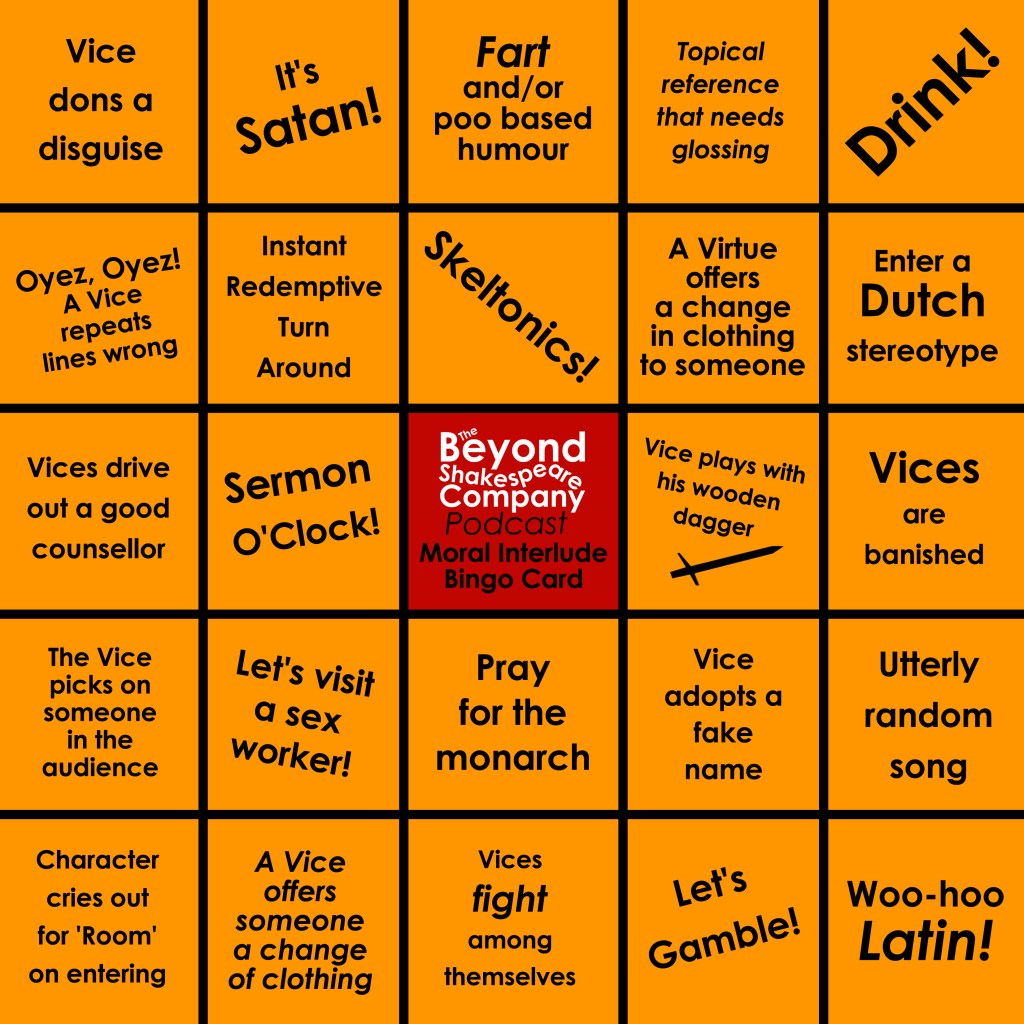
Conventions of the genre shift during the period. The convention of a Vice character (or characters), who is more an agent of darkness/chaos rather than your literal demon, becomes a major element in the shape of the drama. Most plays feature a change of name for the protagonist, either a Vice wanting to sound more virtuous, or a virtue who willingly goes over to vice. The name change often comes with a change of costume or make up, physically demonstrating a change of status. The Vice will probably have a wooden dagger, and threaten someone with violence in the first ten minutes of their entrance. The Vice characters will have a falling out/fight, before getting on with being evil. They will persuade a young person/personification of all humanity to get drunk and visit a sex worker. At the end of the play the Vice figures will be banished, but rarely killed, as they are an ever present threat to the soul of humanity/good order.
The term Vice doesn’t appear until the late 1520’s, early 1530’s with Merry Report in The Play of the Weather by John Heywood. He is unlikely to have coined the term (it probably already existed in the previous decades) so we can’t be sure when this character became a known convention with a name. Anyway, the list of possible Morality Plays continues… some live on the borders.
Tudor Moral Plays – Or are they? Some later variations on a theme
1513 – Youth by the Unknown. A young person is tempted by the pleasures of the world, and is redeemed – Exploring Video
1514 – Hick Scorner by the Unknown. Another young person is tempted by the pleasures of world etc. It is believed that this play is effectively a reworking of the above Youth – Exploring Video
1519 – The Four Elements by John Rastell – borderline for inclusion here as it’s as much a Powerpoint science presentation as an actual moral lesson – First Look Exploring Video, Second Look Take 1 & Take 2
Magnificence by John Skelton – something of an epic, cramming in a host of morality play conventions, but using them to look at an authority figure who has power and their responsibilities – as well as the usual drift towards vice. Exploring Videos
1520’s – We haven’t included here any John Heywood plays, because they are more about debating ideas than explicit moral themes. That said, he is the first author to use the term Vice for the central temper figure.
1538 – King Johan by John Bale – follows in the footsteps of Magnificence and Albion Knight, in that we’re talking about vice and virtue in regards to power – here history and morality collide, as real people interact and merge with allegorical figures. Exploring Videos available.
1544 – The Play of Wit and Science by John Redford – another borderline play, because the moral of the story is about students managing their work life balance. Don’t go over to pleasure too much and forget to study. Again, like Occupation and Idleness, one is encouraged to work, and play, but mostly work. As with most other moral plays, the protagonist Wit is drawn away from the correct path and is later redeemed, though in a more secular way. It is, however, extremely fun. Exploring Sessions.
1550 – Nice Wanton – another story of children who ignore study and give themselves over to pleasure. Don’t have fun people, or you’ll get an STD/die. First Look audio, video, Second Look forthcoming.
1550 – The Disobedient Child by Thomas Ingelend – this appears at first glance to be a slightly odd moral, in so much as the young people at the heart of the play WANT to get married, rather than go off with a sex worker. The play is about parental fidelity, the desire to marry being too quick and not taking into account the father’s wishes. The ending of the play is pretty harsh, forgiveness is distinctly qualified. First Look & Second Look Exploring Sessions.
1553 – Respublica by Nicholas Udall – one of the best examples of a ruler figure being accosted by Vice types. Perhaps the best of the later moral interludes. Exploring Sessions.
1560’s – Like Will to Like by Ulpian Fulwell – another variation on the moral theme, with the literal devil coming down to visit characters who are increasingly real people. Exploring Sessions.
1560’s – Proverb plays of William Wager – William Wager was producing a regular release of plays with titles based on proverbs, and all dancing around the familiar moral themes. Have we drifted too far from the medieval morality play yet? Exploring Sessions.
1572 – The Conflict of Conscience by Nathaniel Woods – though based on a true story, this dark play mirrors Magnificence and other earlier moral themes. Exploring Sessions.
1577 – All For Money by Thomas Lupton – with allegorical figures and a host of other call backs, this play is about living a good life, but the corrupting issue is Money. Exploring Sessions.
Is that it? No. The features of morality plays are now only occasional figures in plays, hints and occasional allegorical characters, but they continue to feature in too many plays to mention. There will be a great continuance in other forms – in printed dialogues, in pageantry and court entertainment – where allegorical figures will address the audience and warn them against sins ancient and modern.
There will be a sister page about Tudor Interludes coming to the website soon – there’s a lot of overlap, but there are also a lot of similarity.
 beyondshakespeare.org